
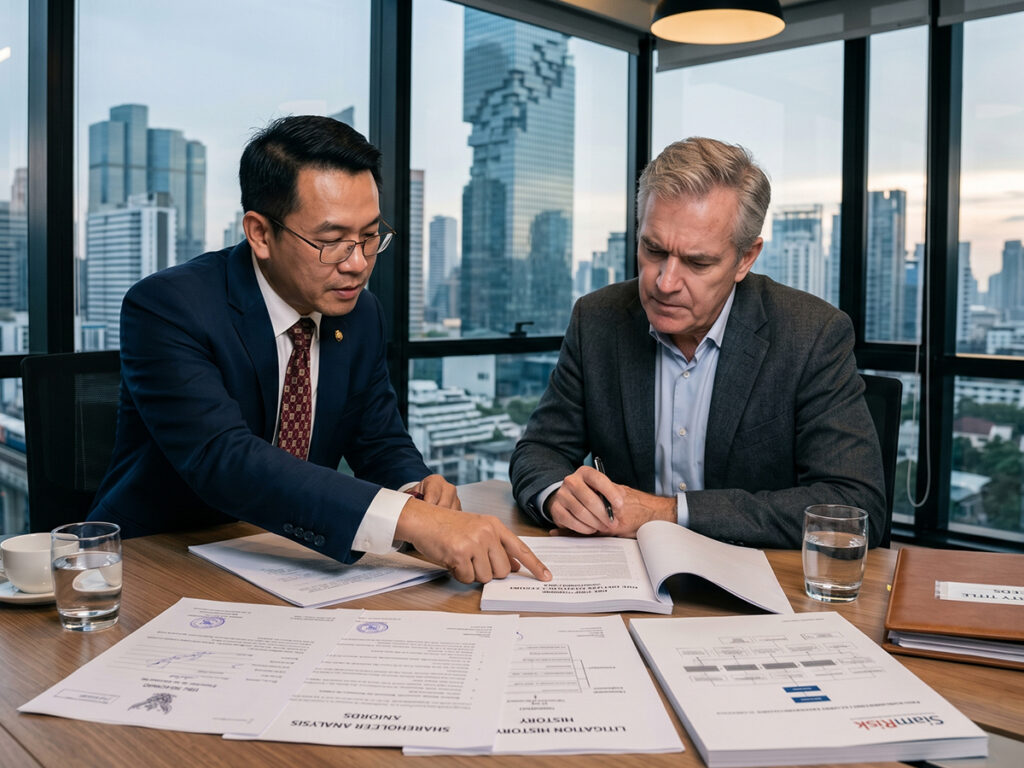
Foreign investors entering Thailand frequently underestimate the importance of due diligence in Thailand. Surface-level checks — a company website, an introduction, or an informal referral — leave significant exposure unaddressed. As a result, risks that could have been identified at the outset tend to surface only after capital has been committed.
In Thailand, proper due diligence is not a formality. It is an investigation-led process that requires coordinated verification across multiple layers. Most investors are unaware of what this actually involves until a problem arises.
What Due Diligence in Thailand Actually Involves
Thorough due diligence in Thailand requires verification across several independent areas. These include Department of Business Development (DBD) records, shareholder and director analysis, litigation and court history, land title verification, and ultimate beneficial ownership (UBO) mapping.
Furthermore, a basic online search will not reveal undisclosed liabilities, nominee structures, or prior commercial disputes. Many high-risk indicators are only visible through local registry access, court filings, and on-the-ground enquiries. Consequently, relying on publicly available information alone creates serious gaps in any risk assessment.
The Real Cost of Skipping Due Diligence in Thailand
Once funds are deployed, recovery becomes complex, slow, and uncertain. Many foreign investors discover legal and structural problems only after signing agreements or transferring capital. By that stage, available options are significantly reduced.
Consequently, prevention is considerably more cost-effective than remediation. Early-stage due diligence in Thailand eliminates exposure before it can escalate into a costly dispute or a financial loss that is difficult to reverse.
How SiamRisk Conducts Pre-Investment Due Diligence in Thailand
SiamRisk coordinates legal, corporate, and intelligence sources to build a complete risk profile before any capital is committed. This includes verifying counterparties, identifying hidden relationships, and assessing both financial and legal exposure.
For independent reference on cross-border investment risk, the UK Government’s overseas business risk guidance provides a useful starting point: UK Overseas Business Risk — Thailand.
Before entering any investment, partnership, or acquisition in Thailand, due diligence in Thailand is not optional — it is the essential first step in protecting your capital. Contact SiamRisk to begin your pre-investment assessment today.
Related Services
To understand how we support foreign nationals and families, please review:
- Crisis Response & Risk Management Framework
- Corporate Investigations Services
- Legal Liaison & Authority Coordination in Thailand