
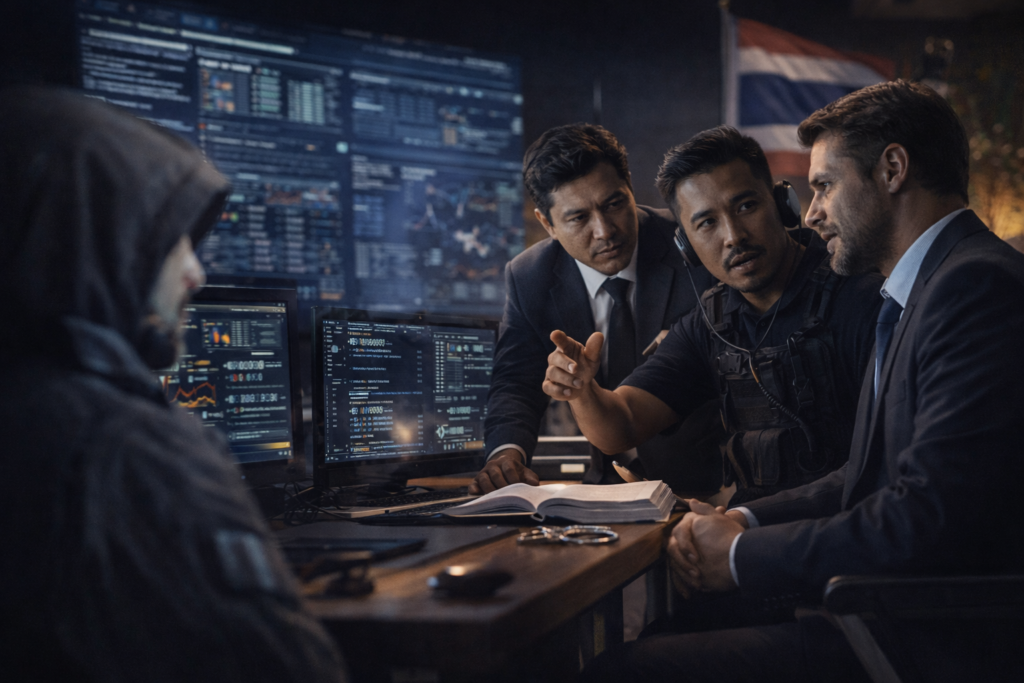
Thailand is a dynamic and competitive business environment. However, foreign-owned companies operating in the region may face heightened exposure to industrial espionage, insider risk and cyber intrusion. Corporate counter-intelligence in Thailand is therefore not a theoretical safeguard — it is an operational necessity.
A foreign-owned company approached SiamRisk after developing credible suspicions that commercially sensitive information was being leaked to a direct competitor. Early indicators included pricing undercuts that mirrored confidential proposals and suspicious digital activity within the organisation’s internal systems.
Identifying Industrial Espionage Risks
Our corporate counter-intelligence in Thailand engagement began with a structured technical security audit of the client’s physical office environment and digital infrastructure. This included:
- Forensic examination of workstations and mobile devices
- Network traffic analysis
- Endpoint vulnerability assessments
- Review of access-control permissions
- Insider risk evaluation
Through detailed forensic analysis, several compromised endpoints were identified, along with unauthorised data-exfiltration pathways that had been operating covertly.
Rather than immediately shutting down all systems — a move that could have alerted the competitor and destroyed evidentiary continuity — we implemented a controlled remediation strategy. This approach preserved intelligence value while mitigating further exposure.
Cybersecurity Remediation and Staff Hardening
Effective corporate counter-intelligence in Thailand requires a layered response. We introduced secure communications protocols, segmented the internal network architecture, and enhanced encryption standards.
Crucially, we addressed the human factor. Staff training was delivered using structured cybersecurity awareness techniques aligned with internationally recognised best practice, including guidance from the UK National Cyber Security Centre (https://www.ncsc.gov.uk/) and frameworks similar to those applied by global risk consultancies such as Control Risks (https://www.controlrisks.com/).
To test resilience, we conducted simulated phishing campaigns and controlled security drills. These exercises materially improved staff compliance, reduced susceptibility to social engineering and strengthened internal reporting mechanisms.
Legal Coordination and Strategic Resolution
In parallel, our corporate counter-intelligence in Thailand operation involved coordination with Thai legal counsel to document admissible evidence consistent with Thai provisions concerning unauthorised access to computer systems and misappropriation of trade secrets.
We compiled the evidence to support formal legal escalation and subsequently issued a formal warning to the competitor through appropriate legal channels. Following structured communication and presentation of evidence, the unauthorised activity ceased.
Integrated Protection in Competitive Markets
This case demonstrates that corporate counter-intelligence in Thailand must integrate:
- Technical cybersecurity
- Legal strategy
- Insider-risk mitigation
- Human-factor training
When these elements operate together, foreign-owned businesses can protect intellectual property, preserve competitive advantage and maintain operational continuity within Thailand’s complex commercial landscape.
Internal Resources
For further insight into our investigative capabilities, please review:
- Crisis Response & Risk Management Framework
- Corporate Investigations Services
- Legal Liaison & Authority Coordination in Thailand